Lucid entry · ~5 min read
What a lucid dream is — and how your month is built
A lucid dream is a dream in which you realize you are dreaming — while the dream is still happening. Not a 'vivid dream', not a 'dream you remembered well', but the precise moment when a clear thought switches on inside the plot: 'this is a dream — and I know it.' From that moment the dream stops merely happening to you: you can observe, act, and steer events — to the degree you learn to.
This is a documented state, not an urban legend. Labs record it objectively: a sleeper who becomes lucid sends a pre-agreed signal with eye movements — the only muscles that stay largely active in REM. Instruments capture that signal against the full picture of deep sleep. That is how Stephen LaBerge's group first proved it in 1981: consciousness inside a dream is a measurable fact.
An important calibration up front: lucid dreaming is a skill, not a switch. Some people get their first result within a week; for most it takes longer; for some it arrives after the course ends — and all three are normal. The goal of this month is not to force a lucid dream at any cost, but to build a system in which it becomes the natural outcome rather than luck.
Let's clear up the three fears that most often stop people from starting.
'This is something esoteric.' No. Everything you will work with — memory, attention, sleep phases — is ordinary physiology and cognitive skills. The course will never ask you to believe anything: every notable claim comes with a study you can open and read.
'I'll get stuck in a dream' / 'it's dangerous.' You cannot get stuck in a dream: sleep ends in waking up, as it always does. The only state in this territory that scares people — sleep paralysis — gets its own calm, evidence-based session in week three: unpleasant, but physically safe and short.
'It won't work for me, I don't even remember dreams.' Dream recall is a trainable skill, and the entire first week is built to accelerate it. 'I don't remember dreams' is the starting point of the majority, not a contraindication.
✦ How common is this
A meta-analysis of 50 years of research: Saunders et al., 2016 (34 studies, thousands of participants).
You are not trying to join a club of the chosen — more than half of all people have already been in this state by accident. The course teaches you to get there on purpose.
The course stands on three pillars, and none of them is accidental:
- Lucid entry — techniques and their right sequence. Not 'twenty methods to choose from' but proven combinations in working order: reality checks, MILD, SSILD, WBTB and their pairings.
- Sleep quality — techniques fail without proper sleep: lucidity appears in REM, and there is most of it toward morning, when sleep is not disrupted. So schedule and recovery are not 'healthy lifestyle box-ticking' — they are the load-bearing frame of the practice.
- Dream understanding — dream recall and knowing your own plots. This is the fuel: you cannot become lucid in a dream you don't even notice. The journal, dream signs, repeats — all come from here.
One day — one short lesson with one concrete practice. There is nothing to configure: you have already taken the diagnostics, and the course sets its own emphasis — what to highlight, which technique to recommend first, what to watch in the check-ins.
How the month is built. Week one is the foundation: journal, dream recall, schedule, reality checks, your first technique. Week two — techniques in earnest: MILD by the science, WBTB, the first full protocol. Week three — the most interesting part: what to do at the moment of lucidity, how not to wake up instantly, and how to hold the scene. Week four — independence: a second technique matched to your diagnostics, a personal protocol, and a post-course plan.
Along the way there are five short check-ins — every few days the course asks how it's going and adjusts its emphasis. Day twenty is the key point of the month: the diagnostics that determine which link breaks specifically for you, and build the final ten days around fixing it.
The honest expectation for the month: a working system — guaranteed; a lucid dream within these thirty days — likely, but not promised. Everyone's pace differs, and pace says almost nothing about eventual success.
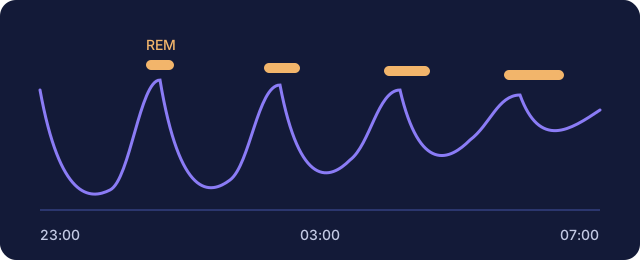
At what time of night is a vivid, long dream most likely?
Today's practice is a single two-minute step. Put a notebook next to your bed or open the notes app on your phone. Tomorrow morning, before getting up, write down whatever you remember from your dreams — even a fragment, an image, or an emotion. If nothing comes, write 'empty': the habit of reaching for the dream each morning already trains dream recall.
This action looks too simple to matter — and it is exactly the one skipped by everyone who later says 'I tried, it doesn't work.' The notebook by the bed is the first brick of the system.
Tomorrow we turn these notes into a working dream journal: the four rules of the protocol and the three mistakes that kill a journal within a week.